



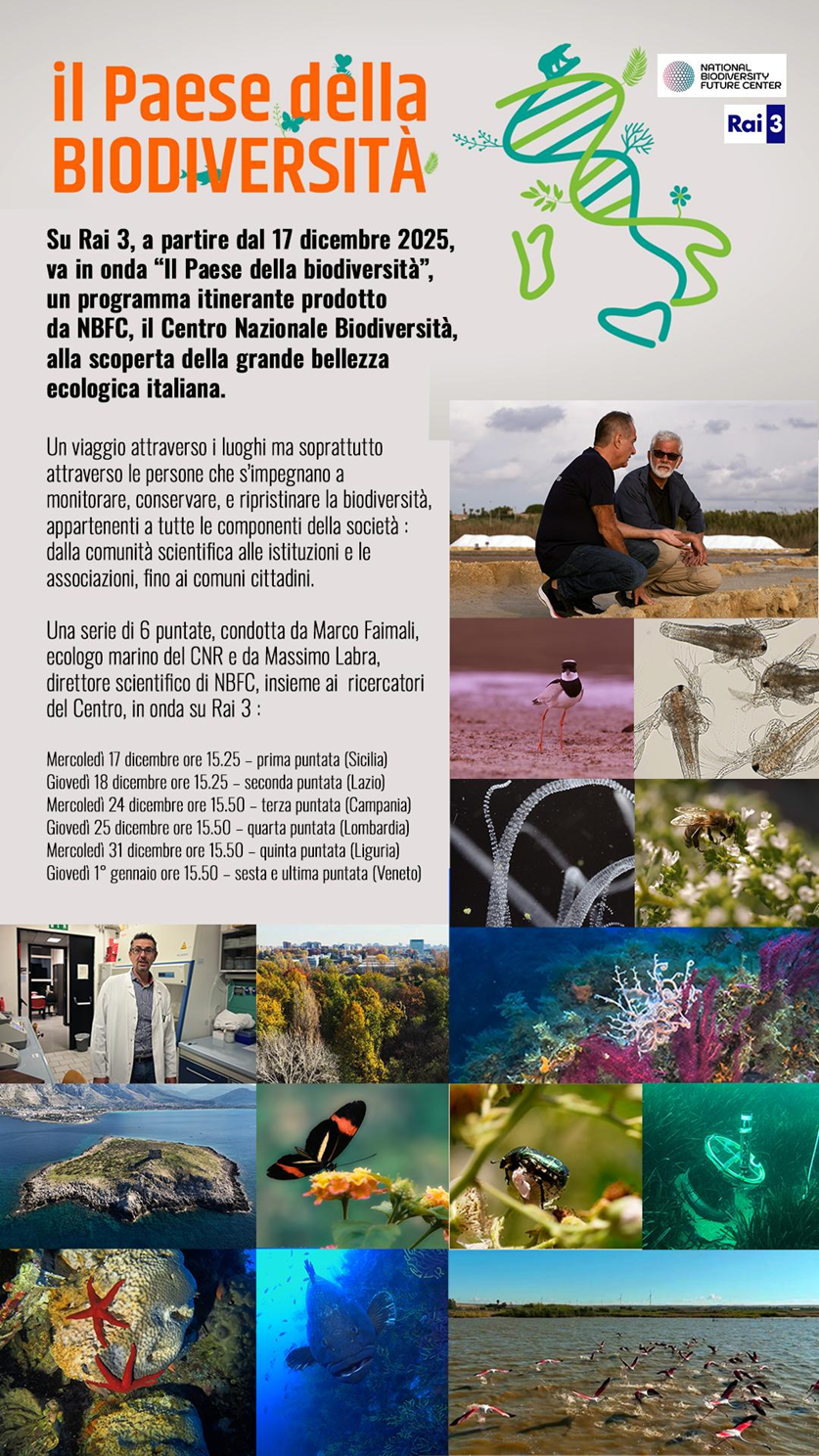
 On Thursday, December 18 at 3:25 p.m. on Rai 3, the second episode of “Il Paese della biodiversità” will air. The programme is a six-stop travelling science outreach series by the National Biodiversity Future Center (NBFC) – Italy’s first national biodiversity research centre, funded by the PNRR – Next Generation EU – in collaboration with Rai Cultura.
This second stop will take viewers on a journey to discover the biodiversity of the Lazio region. Guiding the audience through the region’s natural wonders will be researchers from the Center for Biodiversity: Marco Faimali, marine ecologist at the CNR, and Massimo Labra, Scientific Director of the NBFC, together with journalist Marita Langella.
Zoologist Carlo Rondinini will lead viewers inside the Bioparco di Roma, a valuable zoological garden dedicated to the conservation of endangered species, where the animals do not come from captures in the wild. The Bioparco is committed to recreating the animals’ original habitats and plays a strong educational and scientific role.
Another open-air laboratory can be found, unexpectedly, in the heart of the gardens of Castel Porziano, the summer estate of the President of the Italian Republic. This exploration will be guided by Carlo Calfapietra, Director of the Institute for Research on Terrestrial Ecosystems (IRET CNR), Giuseppe Scarascia Mugnozza, Professor of Silviculture and Forest Ecophysiology at the University of Tuscia, together with Giulia Bonella, Head of the Castel Porziano Presidential Estate Service.
Not everyone knows that iconic chiropterans – that is, bats – are a key component of biodiversity, with over 1,400 species playing vital ecological roles as insect predators, pollinators and seed dispersers. Protecting them requires the creation of green corridors within cities as well, corridors that are in fact essential for all urban biodiversity. Luca Campone, Professor of Biotechnology and Biosciences at the University of Milano-Bicocca and a nutraceutical chemist, will explain how he uses his 3D printer to create very special nests and shelters. Thanks to probes and microcameras, these animal refuges become true miniature monitoring stations.

